Pages

Showing posts with label vegetables. Show all posts

Saturday, August 9, 2014

Golden Chanterelle Fricassee with Fleur d'Ail


Rain may not be super on your summer beach, but it is divine for the forest floor, opening up a lush mush bed for wild mushrooms. After a rainy week earlier this summer, the mushroom man at the local farmers market in the Quebec Laurentians had a happy heap of wild mushrooms. I came back with a paper bag full of golden chanterelles and lobster mushrooms. The natural yellow-gold and apricot of those mushrooms account for the vibrant hue of yellow in this mushroom fricassee.

Fleur d'ail
At the vegetable stall, same farmers market, I routinely bagged a bunch of fleur d'ail. I get it every summer. Crunchy to bite, delicately green, and mildly garlic-fragrant, fleur d'ail (as they are sold in Quebec) or garlic scapes are the budded stems from which the garlic bulb grows. Chopped fine I use it in just about anything: a remoulade dip, with steamed mussels, in a mustard-cream sauce for steak, in a fresh tomato salsa, tossed in with caramelized onions for an onion tart, as the "aglio" in the aglio-olio caprese pasta popular in our house, in a compound butter, to use for instance on escargots gratin, or even as a simple crisp and colorful garnish.

To humor a friend, who is trying to avoid using cream and butter, I am currently also exploring a no-butter-no-cream version of this wild mushroom fricassee. Stay tuned!

Golden Chanterelle Fricassee with Fleur d'Ail
recipe for 2 (main course) or 4 (appetizer)

250gr mixed lobster mushrooms and golden chanterelles (or other wild mushrooms)
2-3 garlic scapes, chopped in thin rounds
1 small to medium onion, sliced thin
1 small leek, sliced thin
1 clove of garlic, crushed
1 tsp Dijon mustard
1/2 cup heavy cream
1 tbsp olive oil
1 tbsp butter

Clean the mushrooms with paper towel gently. If they are all different size, break the bigger ones to equal the size of smaller mushrooms. I had a big lobster mushroom, which I divided into many smaller pieces.

Heat olive oil and butter, until butter is melted. Add the sliced onions and leek, and over low heat, saute them gently until soft (do not brown). Still over low heat, add the lobster mushrooms and garlic, cook for 2 minutes. Stir in mustard and add the heavy cream and fleur d'ail. Simmer gently for 1 minute, and finally add the chanterelles: gently "wiggle" the pan to let the tender mushrooms "sink" into the cream sauce rather than stir them in. Simmer gently for about 10 minutes. Serve immediately.

We had it as a main course, following a mixed green salad. We dipped crusty bread in the sauce, and ate the mushrooms with no interference of any other flavors.


fleur d'ail among good and golden greens
I love to cook with wild mushrooms, here sauteed with veal sweetbreads (recipe here)


Saturday, August 2, 2014

Beach-Dug Clam Chowder

We went clam digging in Maine. What an experience! It had been years and years since I stood hunched over a muddy beach with a shovel and a bucket. At the time, I was a young child on a Zeeland beach on the North Sea coast, digging for razor clams. The idea is the same: you look for a little "air hole" in the sand, and you dig. Not ON the hole, just near enough. And then you claw with your hands in the sand, removing it carefully until you feel the shape of the shell. This time, in Maine, big clams prove worth the finger-scraping effort and the mud-grey nails by the time the tide starts to roll back in.

Beach-Dug Clam Chowder
10 or so big clams (or less if you didn't dig long and hard enough)
1 cup heavy cream
1-2 cups clam juice (what you steamed the clams in)
1 cup diced kohlrabi
1 cup diced potatoes
1/2 cup diced fennel
1/2 cup chopped onions
1 garlic clove, crushed
1 small twig of fresh lovage
1 small bay leaf
1 twig of fresh thyme

Steam the clams open 2-3 minutes in water to which you've added a splash of white wine, a pinch of salt, and some coarse chopped aromatic vegetables like onion, leek, celery and garlic. Let cool enough to handle, then pick out the clam, drain every last drop of clam juice from the shell into a collecting bowl. Strain the steaming liquid from the pan also into this bowl, but use a cheesecloth if the water seems gritty.

Put the kohlrabi, potato, fennel, lovage, thyme, onion, bay leaf and garlic in a pot with the clam juice: use enough clam juice to just cover the vegetables. Simmer for up to 15 minutes, or until soft. Remove the lovage, thyme and bay leaf, and add the cream. Add more clam juice if the soup is too thick (or not if you like it that way). Bring to a slow boil and add the chopped, cooked clams. Turn off the heat, and leave to infuse for 2-3 minutes. Add some chopped chives, and serve with a good chunk of hearty bread and good quality butter.

ps. I made exactly the same chowder minus the clam juice and clams, using fresh haddock.


I cooked this staying at the New Moorings Farm in Sedgwick, Maine. See the story With A Pitchfork In My Kitchen here

Tuesday, July 29, 2014

Beetroot & Horseradish Tzatziki

It took a bit of an effort to wiggle the horseradish free from its rich dark earthen bed. And even more effort to scrape it clean and grate it. But there I had it: grated horseradish, fresh from the small Maine farm where I was staying. The beetroot was so fresh, its juice ran free the moment I cut it. And then there was the garlic: fresh and juicy, it broke rather than crushed when I hit it with the flat part of my kitchen knife. The smell of freshly picked produce, I tell you: it is intoxicating!

Beetroot & Horseradish Tzatziki

2 small beetroot (or 1 medium), grated
1 or 2 cucumber (to make a cup full of grated cucumber)
1 tbsp freshly grated horseradish
1 tbsp chopped chives
1 cup thick (Greek) yogurt
1 tsp Dijon mustard
1 small tsp sea salt (or to taste)
1 large clove of garlic

Grate the cucumber fine and drain in a sieve until most excess liquid is drained off. Add to the grated beetroot and horseradish in a bowl. In another bowl, mix together yogurt, chives, mustard, garlic, and salt. Taste if it is to your liking, and then carefully spoon in the cucumber, beetroot and horseradish.

I served it with toasted pita bread and a side salad of cherry tomatoes, diced kohlrabi, small lettuce leaves, and edible flowers.

I cooked this staying at the New Moorings Farm in Sedgwick, Maine. See the story With A Pitchfork In My Kitchen here


Sunday, April 13, 2014

Lamb Kofte, Saffron Rice, and Colorful Salad

When minced lamb smells good enough to eat raw, close your eyes and you can almost picture the animal running around in a meadow rich with grasses and wildflowers. On my kitchen board was farm-fresh, pasture-raised lamb from a local ranch (link). This lamb begged for fresh herbs, for natural sweetness, for a hint of spiciness. It longed for a gentle roll on the hot grill. This lamb also sought a tantalizing liaison with the vibrant colors and crisp flavors of fresh vegetables, and the fragrance of saffron in rice. This was a weekday meal for us, one we loved so much I decided to cook the same for friends when they came to dinner. And like often, the question arose: "so do you cook like this every day?" Well, yes, I do. When I'm not eating out somewhere.

Dessert was a yogurt-coconut-lemon cake, a recipe for another time. Following recipes are for 3-4: adjust amounts accordingly!

Colorful Salad
1 orange
1 medium fennel bulb
1/2 small red cabbage
4-5 radish
1 medium red beetroot
2-3 scallions
2 small cucumber
fresh herbs (to taste)

vinaigrette
You can use any vinaigrette you like. Here's one I use
2 tbsp olive oil
1 tbsp Tarragon Vinegar (I make my own; use another vinegar if you don't have)
1 tbsp fresh lemon juice
1 tbsp tahina (if you don't like tahina in this vinaigrette, use mustard)
1 tbsp finely chopped fresh mint and parsley

Prepare the vegetables: grate the beetroot, shave fennel and cabbage, slice radish thin, dice the cucumber, and chop the scallions. Layer in a wide bowl. Clean the orange and cut segments (without white). Catch the orange juice that spills and add to the vinaigrette. Add the orange to the salad, scatter fresh herbs over it all. Make a vinaigrette by mixing all ingredients together. Add the vinaigrette just before you're ready to serve. Toss at the table (all separate colors will run red the moment you toss the salad, owing to the beetroot).

Lamb Kofte
500 gr ground lamb
1 tbsp mixed spice (equal amounts of cumin, ground ginger, paprika, cayenne)
1 tbsp finely chopped fresh mint and oregano (2/3 mint, 1/3 oregano)
sea salt & fresh ground pepper to taste
1 tbsp tomato paste
1 tbsp dhibs (date syrup)
1 clove of garlic, minced

Saffron Rice
2 cups basmati rice
4 cups water
1 pinch saffron threads
1 medium/small onion, diced fine
1 tsp salt
1 tbsp butter

Rinse the rice 2-3 times. Pound half of the saffron threads in a mortar and pestle. Bring 1 cup water (of the 4 cups) to a boil, add to the pounded saffron and leave to infuse. Melt the butter in a large pan. Add the onion and sweat gently over low heat until soft and translucent. Add the rice and stir to coat in the onion-butter. Add the pounded saffron, and the water. Add salt to taste, and the rest of the saffron threads. Bring to a boil and let simmer slowly until fluffy and soft.

Cucumber, Mint & Yogurt Sauce
1 cup thick yogurt (if you use plain yogurt: let it strain in a cheesecloth for an hour or so)
1 small cucumber
1-2 cloves of garlic, minced (depending on how much garlic you like)
1 tbsp finely chopped fresh mint
salt flakes and fresh ground pepper to taste

Grate the cucumber, and let it strain in a sieve to get rid of excess liquid. Mix with the thick yogurt, and add garlic, mint, and seasoning.
and this is what happens when you toss the salad: all shades of delicious red

A recent post on Texas Local Meat: In My Kitchen here

My meat came from A Better Way Beef, a local farm I found through www.eatwild.com

Find me on Facebook (here) and Twitter (here)


Friday, March 14, 2014

Squash & Root Vegetable Casserole

Don't you just love the color and variety of root vegetables? From a deep purple potato to the warm orange rutabaga, dark red or golden yellow beetroot, warm white celeriac and parsnip. It is vegetable time!

This Squash & Root Vegetable Casserole is open to interpretation. In fact, so is the name: I've called variations of this dish "curry" and "tajine", depending on the spice mix I used, and pan I cooked it in. Choose your own favorite squash and root vegetables. I use acorn squash here, but made it before with butternut squash (my favorite squash, with its warm color, rich flavor and velvet texture). You can add coconut milk if you like.


Squash & Root Vegetable Casserole 
ingredients
6-7 different squash/root vegetables: I used 1/2 acorn squash, 2 parsnip roots, 1 medium yellow beetroot, 1/2 medium celeriac, 1 turnip, 1 rutabaga, all cut in relatively same size chunks.
1 medium onion, sliced in half moons
500 ml good stock (organic vegetable or chicken)
paste
4-5 cardamom pods
1/4 tsp of each: ground ginger, cumin, turmeric, white pepper
chili flakes to taste
3 garlic cloves
generous tbsp fresh lime juice
4 shallots
1 tbsp olive oil (+ 1 tbs oil for cooking)

  • In a mortar and pestle, pound the cardamom pods until fine (you can use the seeds only, but I usually don't bother separating, and leave the outside skin in).
  • add all the spices and garlic, and pound until forming a paste
  • add the lime juice, then add the olive oil
  • continue pounding carefully (don't splash) until all is mixed into a smooth, runny paste
  • heat a tablespoon olive oil over medium heat. Add the onions and saute for up to 5 minutes
  • add the root vegetables and stir to mix with onions. Let caramelize lightly, stirring regularly for up to 10 minutes
  • add the spice paste, stir well to coat all vegetables, and cook for 1-2 minutes (not too long, or it will become bitter)
  • add the stock, stir all together, and bring to a boil
  • over low heat, simmer for 20-30 minutes or until the hardest vegetable (in my curry that was the beetroot) is soft.

You can serve this as a main course with rice. I served it with a homemade salsa verde as well. Now, if your family is like mine, they will love it yet will also mutter how great this would be with grilled lamb chops!


you may also like my Many Vegetable Lasagna and In My Kitchen: Six Months After Leaving Dubai

Find me on Facebook
Find me on Twitter


Tuesday, January 28, 2014

Roasted Golden Beetroot and Lobster Risotto

I like to roast beetroot bulbs. It brings out their natural sweetness, and deepens their flavor. It makes for instant flavor when you use them in a soup, or like here: in a risotto. Roasting also deepens the color, and the roasted golden beetroot gives the risotto a warm golden yellow. The eye does not go wanting with this risotto!

Ingredients (makes for a main course for 4)

2 cups Arborio rice (or other risotto rice)
100 gr butter
20 gr onions, finely chopped
1-2 liter good, flavorful stock (from scratch or organic cube, your choice vegetable or chicken)
40 gr parmesan cheese, grated
your flavor ingredient(s): in this case 1 cup finely diced roasted golden beetroot
2-3 medium cooked lobster tails, cut into chunks

It is important to have a good, flavorful stock: the grains will soak it up and make or break your risotto. If too bland, your risotto will be bland too. For the risotto you are making, add part of your flavor ingredients to the stock to simmer at least 30 minutes prior to using the stock. For instance, if you're making a mushroom risotto: add mushrooms to the stock. I added chopped beetroot to the stock prior to using it. Also, be playful with your stock: add aromatic herbs and scraps from vegetables to deepen the flavor.

Directions (to make a risotto this way will take about 20-25 minutes start to finish)
  • gently soften the onions in 1/3 of the butter
  • add the risotto grains to "roast" (but not brown): you will notice they get a little glossy
  • add a ladle of hot stock: the shock makes the grains absorb the liquid rapidly and soften the starch to be released. When the liquid is all soaked up, add another ladle. 
  • this is the process for the next 20 or so minutes: add a ladle of stock every time the liquid is incorporated. Stir to get all the grains off the sides of the pan and bottom, and simmer. I don't stir continuously, but am close to the pan at all times.
  • After about 10 minutes, add half of the diced beetroot with your next ladle of stock.
  • Continue to add stock and stir until the risotto starts to thicken (it will look creamier and grains have swollen in size). At this point, taste a grain and check for desired tenderness. You are looking for a little bite, but nothing "chalky". If still too firm, continue with stock and stirring. If soft enough to your liking, and not a hint of chalkiness: take off the heat, add the remaining beetroot, grated parmesan and butter. Stir well to incorporate.
  • Add another ladle of stock if you want your risotto a little "runny". Add the lobster chunks to warm through (or warm separately and serve on top of risotto).
Garnishing herbs that will go well with these sweet and seafood flavors are fresh chives, young parsley, or even fresh (wild) thyme. I also like to sprinkle a couple of rose peppercorns.

ps. you could use the lobster heads for the stock. I didn't, as I find it makes the risotto overly sweet, whereas a hearty, herb-rich stock adds more savory notes to the sweetness of the golden beetroot and lobster meat. I do, however, use the "coral" chopped up and added to the risotto.
the natural beauty of golden beetroot


Saturday, December 21, 2013

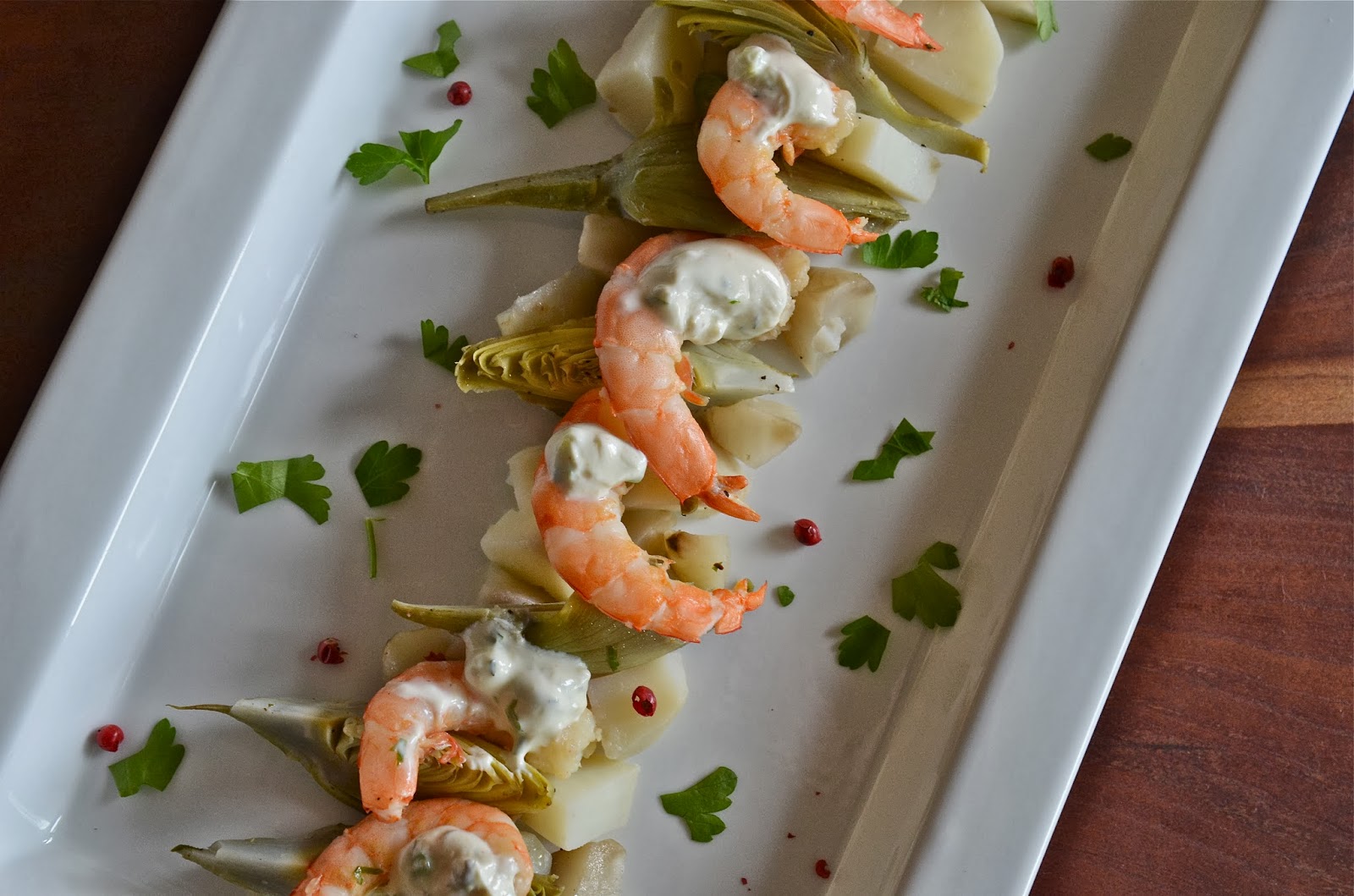
"Shrimp Boil" & Artichoke Salad

This recipe is based on leftovers, from fresh artichokes and roasted sunchokes to a precious gift: a ziplock bag full of leftover shrimp boil. A shrimp boil is a one-pot meal that starts with a good, well-spiced stock in a large pot with strainer. My friend cooks it outside, on a big burner. A born and bred New Orleanian of Italian descend, he is one of these innate gourmands whose body language even changes when talking about food. As if he's physically embracing all the deliciousness of what he is talking about. His eyes sparkle with pleasure when he describes a recipe, a method of smoking, a time to "soak up all these flavors".

In making shrimp boil, he carefully seasons his stock, always smiling when he mentions the "holy trinity" of Cajun cooking: onion, bell pepper and celery. When he is happy with the taste of the stock, he adds skin-on baby potatoes, pieces of andouille, and whole button mushrooms, each ingredient enjoying the interaction of giving and taking flavor. He adds corn on the cob just before adding the main characters: a huge heap of unpeeled shrimp. He stirs, times, tastes, stirs again, fishes out a potato, breaks it open, takes a bite, looks pensive across to the rest of us, and - nodding happily - he grabs the bag of ice he has ready, and empties it in the steaming hot pot of shrimp boil. It is to stop the cooking. He leaves the shrimp to soak up all the flavors, and shortly after lifts out the strainer. The shrimp boil is ready to be eaten. He can't wait for the crawfish season to begin, he says. And the mere thought is making my mouth water.

When we left that evening, he rushed to the fridge and handed me a ziplock bag with leftover shrimp boil. The only reason there were any leftovers, by the way, is that his generous shrimp boil had been preceded by an irresistible scrumptious house-smoked turkey and andouille gumbo.

Below recipe gives an option for this salad if you do not have leftover shrimp boil. As for the roasted sunchokes and artichokes, they were leftover from another meal (with seared tuna). Note: while roasted sunchokes are divine, and will add a great dimension to this salad, they are also not always available. So add if you can find them, but don't despair if you have none. The main flavor-interaction is between the shrimp and artichokes, liaised with the sour cream "tartar". Just make sure you use fresh artichokes!

"Shrimp Boil" & Artichoke Salad with Sour Cream Tartar

Appetizer for 4

16-20 peeled large cooked shrimp
2-3 roasted sunchokes, cut into smaller pieces (optional)
4 cooked baby potatoes, halved
4 cooked button mushrooms, halved
4 cooked small artichokes, quartered*

Sour Cream Tartar
1 cup sour cream
1 tbsp Dijon mustard
1 tbsp finely chopped fresh parsley
1 clove of garlic, minced
1-2 small cornichons, chopped fine
1/2 tbsp capers (tiny ones or chopped larger ones)
1-2 slices jalapeno, chopped (optional)
1 tbsp chives, chopped fine
salt/pepper to taste
lemon juice to taste

For the sour cream tartar: mix all ingredients together, taste, and adjust to your liking. Make a little ahead so the flavors can mingle!

Being leftovers from a shrimp boil, your potatoes, mushrooms and shrimp will be bursting with flavor. Simply use as is, and arrange with artichoke quarters and sunchokes on a plate. Add dollops of the sour cream "tartar" et voila.

If your salad-ingredients do not come from a shrimp boil, you could cook the baby potatoes, mushroom and shrimp in a flavorful stock (including bayleaf, celery, bell pepper, onion, garlic, cayenne pepper) as follows: start with the potatoes, then add the mushroom, and last: add the shrimp. 


Arrange all ingredients on a plate or platter, top with the shrimp, add dollops of sour cream, and serve.
if you can't find baby artichokes, use large ones: boil them as you would an artichoke, eat the fleshy ends of the leaves with a dipping sauce, and keep the heart (bottom) for this salad.
* baby artichokes can be eaten whole. You take off the hard outer leaves, cut the sharp tops of all leaves, peel the stem back. Rub with lemon juice. I quarter the artichokes before boiling: I trim the inner core (usually fibrous and hairy in larger artichokes, in baby artichokes it's just a tiny bit of fuzz), trim the harder top some more, and then boil the quarters until soft. Immediately after, put in ice water to cool down. Drain and use.

Don't forget to like Life In The Food Lane on Facebook (here)

Saturday, June 15, 2013

Beetroot Polenta Croquettes with Mango Ratatouille


It is time for another "leftovers" recipe. This time, I am using leftover beetroot polenta to make croquettes, and leftover roasted eggplant and capsicum to combine with mango and cherry tomatoes into a ratatouille.

Because of the nature of leftovers (it is what is left over from my meal, not necessarily yours!), I give you the recipes to make from scratch.

These are two separate recipes that combine extremely well together in an all vegetarian meal.

The recipe here is one that I vary with polenta and risotto, and of various flavors at that.


Beetroot Polenta Croquettes

For the polenta
medium beetroot bulb
1 clove of garlic, crushed and minced
2 cups (or as needed) vegetable stock (from organic cube is fine)
1 cup (organic) fine polenta
1/2 cup grated parmesan
salt/pepper to taste
Breading
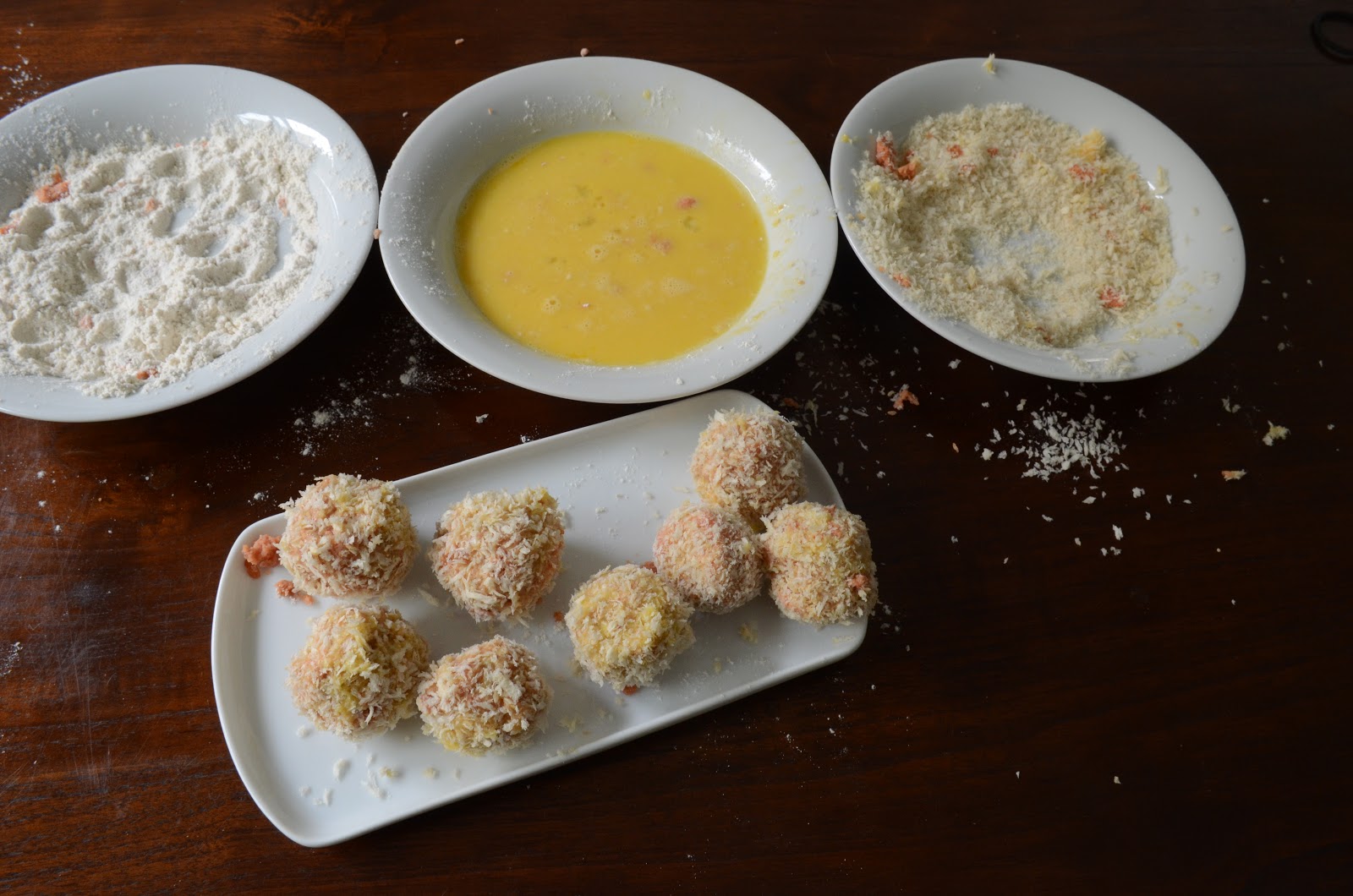
one (small) bowl each of flour, beaten egg and breadcrumbs
  • Grate the beetroot on a fine grater (it goes into the polenta: you do not want large chunks). 
  • Bring 2 cups of vegetable stock to boil, add the grated beetroot and garlic. Bring to a boil and simmer for about 20 minutes to cook the beet, and infuse all the flavors. 
  • Add the polenta, and stir well. It will thicken quickly, and depending on the quality polenta you use, you may need to leave it to bubble and frequently stir. If the polenta gets too thick, add more water (gradually) or milk for creaminess. You want a polenta that is firm enough to cut into squares and grill, or as in this recipe: roll into balls to bread and fry.
  • Taste polenta, adjust seasoning and add parmesan. Pour the cooked polenta into a tray to cool.
  • When cool enough to handle, roll into balls to be breaded.
  • set up your "breading station": the bowls of flour, beaten egg and breadcrumbs (I like to use Japanese Panko*, but you can use any breadcrumb you like. Or try breading with cornmeal, for instance!)
  • The polenta croquettes are now ready to deep fry: heat oil to 180C and fry the croquettes until golden and crisp (4-5 minutes)
*Panko are flaky, coarse Japanese breadcrumbs. Panko tends to soak up less oil and has a very light crunch.

Ratatouille of Roasted Eggplant, Red Pepper, Cherry Tomatoes and Mango
1 medium eggplant, diced
1 red capsicum diced (or roast whole, peel and seed, and then dice)
1 cup cherry tomatoes, halved
1 cup mango (one that is not too ripe), diced
1 small red onion, sliced
1 clove of garlic, crushed
1 tbsp olive oil
salt/pepper to taste

This is an all-oven roasted, dead easy recipe for ratatouille. I made mine with leftover eggplant and capsicum that was already roasted, so I merely sauteed the onion, added all other ingredients at once and warmed through for about 5-10 minutes on low heat.

If you roast all in the oven, you will have to watch timings: start with the eggplant, capsicum, and onion. There are many kinds of mango "out there", varying from sweet with hints of coconut, to sour and almost savory. I like a mango in this recipe that has a bit of acidity and is not overly sweet. However, the recipe works with whatever mango you like (or for that matter: is available). Use a mango that is not too ripe.
  • Preheat the oven to 200C
  • Season the eggplant and red pepper (if you are using from raw), mix with the sliced onion, toss with the olive oil and roast for 20 minutes, or until caramelizing and getting soft. 
  • For the last 5 minutes: add the garlic, cherry tomatoes, and mango for the last 5 minutes. Mix in carefully!
  • Season to taste
This recipe also featured in a previous post: Mango Mania (here).


Follow Life in the Food Lane on Facebook for updates on new posts and other adventures in the Food Lane.

Tuesday, April 23, 2013

Mango Mania: Soup, Ratatouille and Upside Down Cake


“Langras from Benares, for those who liked their mangoes tart; dussebris from Lucknow for those who liked them sweet and smooth; and chusnis, small sucking mangoes for those who preferred not to eat the fruit at all but to suck the juice straight from the skin.” (from: Climbing the Mango Trees by Madhur Jaffrey)

Flaming red to pale green, the mango is a fascinating fruit. It can be oblique oval, round as an apple, flat oblong, or shaped like a kidney. It can be big as a football, or small as a duck’s egg. Mango is a stone fruit, revered for its juicy, buttery soft flesh. It has a unique aroma that lingers between peach and pineapple, with a hint of citrus.
Color is not always an indication that a mango is ripe. A ripe mango smells “ready to eat” (smell it around the stem). It has a sweet fragrance, and feels soft under the skin. An overripe mango bruises easily, and smells cloyingly sweet. You can buy unripe mangoes, and leave them at room temperature to ripen. As for fibrous mango: the flatter ones (and flesh closer to the stone) can be very stringy. In that case, hold the mango over a container and “strip-squeeze” the pulp off.

This time of year (in Dubai) sees an abundance of fresh mango flown in from India and beyond. It is an abundance that brought on a mango mania in my kitchen. Below are three recipes with mango. Enjoy!
curried carrot and mango soup, served chilled
A Three Course Mango Meal

Curried Carrot and Mango Soup 
(makes 1 liter)
2 large carrot, diced (makes about 2 full cups)
1 medium sized mango, just ripe (you want a tart, not too sweet mango), diced
1 small/medium red onion, diced
1 tbsp curry powder (use your own favorite)
1 tbsp vegetable oil
3 cups (approx) vegetable stock 
1 cup coconut milk (coconut milk + stock is about 1 liter)
the juice of 1 small lime (to taste if your mango is sweet, leave out if you use a sour mango)
salt/pepper to taste
crème fraiche (optional)
fresh koriander (optional)
  • Heat the oil. Add onions and fry gently over low heat until soft. 
  • Add the carrots, stir well and leave to cook for about 10 minutes, stirring occasionally. 
  • When the carrots have softened (and a little caramelised), add spice mix and stir.
  • Mix coconut milk and stock together and add 3/4 of it to the carrots (keeping 1/4 to add at the end if needed). Simmer for 20 minutes.
  • When the carrots are really soft (you can squash them easily with a fork), add the diced mango and simmer for another 5 minutes. 
  • Add the lime juice (if the soup is on the sweet side). Puree until smooth with a (hand-held) blender, adding the remaining stock as needed. Taste, and garnish with crème fraiche and koriander.
  • Serve hot or cold.
curried carrot soup served hot with koriander and a dollop of creme fraiche

    Ratatouille of Roasted Eggplant, Cherry Tomatoes, Red Pepper and Mango 
    (4 side portions)
    1 medium to large buttery sweet mango, diced
    1 large eggplant, diced
    1 red pepper (capsicum), cleaned and diced
    1 cup cherry tomatoes, halved
    1 medium onion, sliced
    2 cloves garlic, crushed and minced
    pinch cayenne pepper
    pinch cumin
    pinch paprika powder (preferably smoked)
    salt/pepper to taste
    • Preheat the oven to 200C. 
    • Toss the eggplant, onion, and red pepper with a little olive oil, the spices and some salt in an oven tray.
    • Roast in the hot oven for 20 -30 minutes, tossing 2-3 times. 
    • The vegetables are ready when they are starting to char a little, and have softened. 
    • Add the diced mango, mix in gently. Do the same with the cherry tomatoes. Roast for another 3-5 minutes (depending on how "roasted" you want the tomatoes to be).
    • Serve as a side dish with roast chicken, quail or duck for instance. Or with grilled fish. It makes an excellent vegetarian salad tossed with quinoa, and even better served with grilled halloumi.
    mango ratatouille with quinoa and roasted quail
    Raspberry and Mango Medley Upside Down Cake

    top
    50 gr unsalted butter
    100 gr raw cane sugar
    2 cups ripe various mango, cut into chunks*
    1 cup raspberries
    note: adjust the amounts of raspberry and mango to your own liking
    batter
    100 gr soft unsalted butter
    125 gr granulated sugar
    1 tsp vanilla extract
    pinch of salt
    1 tsp finely grated lemon peel
    2 large eggs
    200 gr self-raising flour, sifted
    ¼ cup milk (approx)

    *choose a selection of different mangoes for this cake if you can. In this one, I used badami, Alphonso, and long Kenya mango. It makes for variation in color and taste.

    Cake pan choice:
    You can choose the diameter of your cake pan depending on the kind of cake you want. A 20 cm diameter will  give you a taller cake with a thicker fruit top (it will also need longer in the oven at a slightly lower temperature (175C). In a cake pan of 25cm diameter, your cake will be more of a pie (flatter), be more sticky (the caramel has more surface to bubble into the batter).
    • Preheat the oven to 190C (175C if using a 20 cm cake pan). 
    • Melt the butter in the cake pan. Add the sugar and melt until dissolved. Let the caramel cool. Divide mango and raspberry over the caramel in a regular pattern.
    • Beat butter and sugar together until smooth and pale. Add vanilla extract and grated lemon peel. Add eggs one by one, plus vanilla extract and salt. 
    • Add half of the sifted flour and gently mix in. Add the rest of the flour . Add enough milk for a smooth, spreadable batter. 
    • Spread carefully over the arranged fruit. 
    • Bake in the oven for 30-40 minutes (slightly longer for 20 cm cake pan). Check after 30 minutes with a toothpick: if it comes out clean, the cake is done. If still wet, continue to bake and check every 10 minutes.
    • Let the cake cool for about 20 minutes, then turn over on a plate (careful, caramel is still hot)
    25 cm cake pan raspberry and mango medley upside down cake
    20 cm cake pan upside down mango cake

    • The Mangifera Indica is native to South Asia, where it was first cultivated over 4000 years ago. Legend tells that a mango grove was planted for the Buddha to find a shady place to rest. Fossil evidence found in India indicates that the mango tree already existed 25-30 million years ago.
    • Mango is a powerful antioxidant and an excellent source of Vitamins A, B, and C, minerals, and dietary fiber.
    • an extensive list of mango cultivars is found on Wikipedia (here)
    • Each year at the end of June, the International Mango Festival in Delhi is a 2-day festival where you can sample over 1100 mango varieties. 
    • Climbing the Mango Trees by Madhur Jaffrey is a memoir of storytelling and childhood memories of her family life growing up in India, with the common thread of food weaving through the book. I loved it.
    Follow Life in the Food Lane on Facebook for updates on new posts and other adventures in the Food Lane.

    Monday, March 25, 2013

    The Pantry Appetizer Platter

    For a wine evening, I had said I would bring "a plate of something". That "something" wasn't defined until after I rummaged in fridge and pantry, and scanned over the herbs I have in my garden (the ones that survive my very un-green fingers). I love this kind of cooking: be creative with whatever your pantry and fridge hold for you. It is also a fabulous way to use leftovers and/or items that need finishing.

    For this evening, I found a can of white beans, a chunk of parmesan, mild chorizo, fresh lemons, a large eggplant, leftover roasted red capsicum, soft goat's cheese, cream cheese, leftover sun-dried tomato tortillas, olives (from Markets and Platters), salami, and rosemary and basil begging to be picked.

    A platter of a white bean dip, roasted eggplant relish, and creamy goat's cheese pinwheels was in the making.
    white bean dip sprinkled with leftover dried espelette (see lamb shanks )
    White Bean, Rosemary and Parmesan Dip
    1 can white beans
    juice of a lemon (or to taste)
    1 clove of garlic, crushed and minced
    olive oil
    salt/pepper to taste
    1/2 cup grated parmesan (or to taste)
    1 sprig of fresh rosemary, leaves chopped
    • as if making a classic hummus, pulse the white beans in a food processor with olive oil, lemon juice, and garlic until smooth but still thick in consistency. 
    • heat a tablespoon of olive oil in a frying pan. Add the chopped rosemary and quickly stir until you can smell its fragrant essence (it is less than a minute).
    • Add the rosemary as well as the olive oil it fried in to the white beans, pulse some more. Taste and adjust seasoning.
    • spoon in the grated parmesan, and there you have it: white bean, rosemary and parmesan dip

    Roasted Eggplant and Chorizo Relish
    1 large eggplant
    1 roasted red capsicum, skinned, seeded, and diced very small
    1/2 cup chorizo, diced small
    1 tbsp olive oil
    1 pinch of espelette (or chilli powder to taste)
    salt/pepper to taste
    fresh lemon juice (to taste)
    • Cut the eggplant in half lengthwise, and make a couple of cross cuts in the flesh (do not cut through to the skin). Sprinkle with coarse salt and a little olive oil, and roast in a hot oven (200C) until soft.
    • Scrape the eggplant flesh out, and discard the skin. 
    • "dry fry" (means without adding oil) diced chorizo in a hot nonstick frying pan until its oil comes out. Do not brown or fry overly crisp. Drain and add to the eggplant. Add the chorizo oil if you like.
    • Add the diced red pepper, the lemon juice, espelette or chilli powder, and season (all to taste)
    • Mix all ingredients well together, and let stand for at least 30 minutes to infuse all flavors before serving.

    Goat Cheese, Basil and Pine Kernel Pinwheels

    4 medium size round soft tortillas (I had sun-dried tomato tortillas in my fridge)
    100 gr creamy goat cheese, room temperature
    100 gr cream cheese (philadelphia), room temperature
    1 cup fresh basil leaves
    1 tbsp toasted pine kernels
    • In a mortar and pestle, pound the basil leaves to a paste, add the pine kernels mid-way. 
    • In a deep bowl, mix together the goat and cream cheese until smooth, and add the very basic pesto of basil and pine kernels (I did not add garlic: I think it takes away from the flavors of the goat cheese mixed with fresh basil and nuttiness of the pine kernels, but feel free to add it!). Leave to infuse for at least 10 minutes.
    • Spread the goat cheese and basil mixture in a generous layer on a tortilla.
    • Roll up tight carefully. Repeat with the remaining tortilla and cheese mixture. 
    • Wrap the rolls in plastic and chill in the fridge for at least one hour.
    • Cut just before serving into 1cm wide "rings" and let come to room temperature.


    Sunday, October 14, 2012

    Sarawak Black Pepper Sauce & Caramelized Eggplant


    This recipe post is a "follow-up" to my blog post Sarawak's Indigenous Food Treasures (here). Black Pepper Sauce is popular throughout Malaysia and Singapore. It is a dark and syrupy (Chinese) sauce with many layers of salty and sweet, acidity and spice. Oh so good with beef, this sauce loves to stick to stir-fried prawns, crabs, tofu, and even vegetables just as well. You can use any black pepper, but Sarawak Black Pepper gives it an extra aromatic dimension.

    This recipe is my version of Black Pepper Sauce. It is loosely based on how I've seen it prepared in Miri (Miri has a large Chinese population). Or rather, what I saw going into the wok: never did I see any of them use exact measurements. I use a good measure of kecap manis (sweet soy sauce), because I like the sweetness set off against the spiciness of the black pepper. Feel free to adjust ingredients to your personal taste.

    what can I say, I felt creative 

    Sarawak Black Pepper Sauce
    (makes about 1 cup)

    1 full tbsp coarsely pounded Sarawak Black Peppercorns
    1 medium red onion, chopped fine
    1-2 cloves of garlic, minced (roughly 1 tbsp)
    1 inch piece fresh ginger, grated
    1-2 red chilies (heat to taste)
    1 tbsp Belacan* (shrimp paste, if you don't have belacan use any other)
    1/3 cup kecap manis (sweet soy sauce)
    1/3 cup (salty) soy sauce
    1/3 cup tbsp oyster sauce
    oil for stir-frying

    Pound onion, ginger, garlic, and chillies into a paste using mortar and pestle. Add the belacan paste and pound some more. By all means, use a blender if you prefer. Heat the oil in a wok or shallow pan. Add the pounded paste and stir-fry until soft and fragrant. Add both sweet and salty soy sauce, as well as the oyster sauce. Reduce over low heat until thick and syrupy. Add a few drops of water if the sauce gets too thick. Add the coarsely pounded black pepper, stir in well and simmer for another 2-3 minutes, until all the aromas and flavors have blended.

    Ideally, the sauce gets time off-heat to infuse all its flavors of sweet, salty, acidity, and heat. You can use it immediately, but it is even better if you leave it be overnight.


    Caramelized Eggplant with (Sarawak) Black Pepper Sauce

    Slice eggplant in 1cm thick slices, and sprinkle with a little coarse salt. Heat vegetable oil in a skillet and pan-fry the eggplant until it is soft and caramelized. Stack the slices, spooning a lick of black pepper sauce in between the slices. Drizzle some more black pepper sauce on top and serve.

    Beef Tenderloin with (Sarawak) Black Pepper Sauce & Grilled Fennel
    Another favorite: tender beef fillet, cubed and stir-fried quickly with this sweet spicy black pepper sauce. Serve with grilled fennel: the hint of licorice in the fennel pairs very well with the sweet-savory spiciness of the sauce.

    Beef Tenderloin stir-fried with Sarawak Black Pepper Sauce and Grilled Fennel
    ready to pound the Sarawak black peppercorns

    Follow Life in the Food Lane on Facebook for updates on new posts and other adventures in the Food Lane.